 Skip to content

Choosing the right Uv Hydrogel Film in 2026 requires more than comparing price and packaging. Global buyers now examine flexibility, optical clarity, touch response, edge coverage, and long-term surface recovery. A reliable film should fit curved screens without lifting around the corners. It should also withstand repeated contact with keys, coins, and dusty pockets.
This guide introduces leading types, including clear self-healing films, matte films, privacy versions, anti-blue-light options, and stronger TPU-based constructions. Each type serves a different market. Clear films suit premium smartphones and retail displays. Matte surfaces reduce fingerprints and glare in bright offices. Privacy films help users limit side-view exposure during travel. However, performance claims need evidence. Supplier samples, controlled drop tests, abrasion checks, and independent optical reports provide more confidence than attractive brochures.
Small details matter.
Experienced buyers should review thickness tolerance, adhesive consistency, installation tools, packaging quality, and production traceability. Batch records can reveal whether the same material reaches every shipment. Regional requirements may also influence labeling, recycling information, and chemical documentation. These checks support responsible purchasing without relying on unsupported marketing language.
No film is perfect. A softer hydrogel layer may recover minor marks, yet it can feel less rigid than tempered glass. A privacy layer may reduce brightness, especially outdoors. Some anti-blue-light products may alter color perception. This guide therefore compares practical strengths and weaknesses, not just sales promises. It also recognizes an uncomfortable point: the “top” choice depends on the device, buyer expectations, climate, and distribution channel.
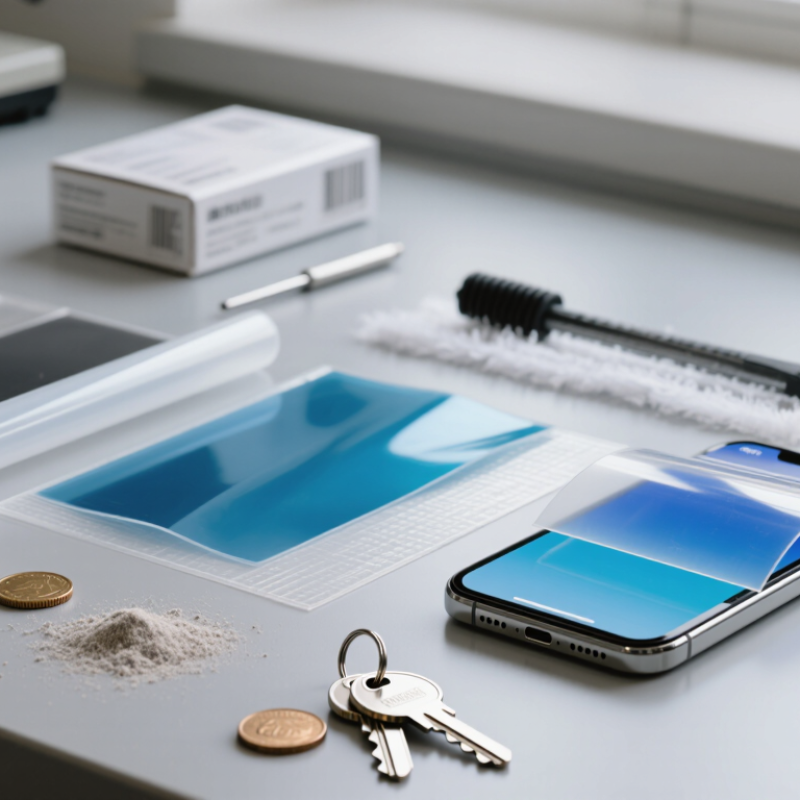
A UV hydrogel film usually combines a flexible polyurethane or TPU carrier with a UV-reactive adhesive layer. Ultraviolet light cures the adhesive after installation, helping it flow around curved edges and small surface marks. However, “UV hydrogel” is not a universal material standard. Some products use TPU, while others use PET or multilayer blends.
The core difference is flexibility. TPU absorbs impact better and follows curved screens, but it may show slight surface recovery marks over time. PET offers stronger dimensional stability and clearer optical performance, yet it feels less forgiving on curved glass. Hybrid films balance both properties, though their adhesive consistency can vary between batches. Canalys reported about 1.22 billion smartphone shipments globally in 2024, showing the scale of potential film demand. Smithers’ 2024 UV-curing market review also identifies electronics as a major application sector, but it does not measure phone films specifically. That distinction matters.
Tips: Ask suppliers for haze, adhesion, thickness, and abrasion data. ASTM D1003 can support haze testing, while ASTM D3359 helps assess adhesion. Check UV dose, curing time, and edge lifting after 24 hours. Do not trust “self-healing” claims alone. In practical testing, dust control often matters more than the film formula. A clean room is ideal, but not always realistic.
| Film Type / Construction | Core Material | Typical Structure and Thickness | Optical Performance | Flexibility and Impact Behavior | Adhesion and UV-Curing Characteristics | Key Advantages | Main Limitations | Typical Applications |
|---|---|---|---|---|---|---|---|---|
| TPU Hydrogel Film | Thermoplastic polyurethane film with a soft hydrogel or pressure-sensitive adhesive layer. | Commonly supplied as a thin single-layer or multilayer film, often approximately 0.15–0.35 mm excluding the release liner. Exact thickness varies by application. | Usually high transparency when well formulated. TPU grades can provide good optical clarity, although haze may increase after surface wear or contamination. | High flexibility and elastic recovery. Conforms well to curved displays and can absorb minor surface contact impacts without cracking like brittle glass. | May use pressure-sensitive adhesion or a separate UV-curable liquid adhesive. If UV adhesive is used, complete curing requires suitable wavelength, intensity, exposure time, and access to the adhesive layer. | Flexible, conformable, easy to cut, and suitable for curved or irregular screens. | Lower scratch resistance than tempered glass unless a hard-coat layer is added. Soft surfaces may show indentation, self-healing marks, or fingerprint buildup. | Smartphones, curved displays, smartwatches, automotive displays, and other flexible or contoured screens. |
| UV-Cured Acrylic Hydrogel Film | UV-curable acrylic resin or acrylate-based gel system, generally cross-linked by photoinitiators during ultraviolet exposure. | Usually a thin polymer film combined with a liquid or semi-liquid UV-curable adhesive. Final bond thickness depends strongly on the coating gap and curing process. | Can provide very good wet-out and low initial air entrapment when properly applied. Optical clarity depends on resin purity, curing uniformity, and the absence of bubbles. | Moderate flexibility after curing. The cured adhesive is normally less elastic than an uncured gel and may become too rigid if over-cured or formulated with a high cross-link density. | Requires controlled UV exposure. Excessive exposure can increase brittleness, while insufficient exposure can leave residual monomer, weak cohesion, or surface tack. | Strong glass-to-film contact, good edge wetting, and effective optical coupling on compatible surfaces. | More process-sensitive than ordinary pressure-sensitive adhesive films. Removal may require controlled peeling and residue cleaning. | Full-cover screen protectors, curved glass installation, display repair, and applications requiring strong optical contact. |
| TPE-Based Hydrogel Film | Thermoplastic elastomer, such as a styrenic block copolymer or olefinic elastomer, combined with a gel-like adhesive or soft protective layer. | Generally designed as a flexible multilayer construction. Thickness is commonly selected according to the required stretch, cushioning, and handling properties. | Transparency can be good, but optical haze and color stability depend on the elastomer type, plasticizer or additive package, and surface coating. | Very soft and stretchable. It can conform to curved surfaces well, but excessive stretching during installation may cause dimensional recovery or edge lift. | UV curing is normally associated with a separate UV-curable adhesive layer rather than the thermoplastic elastomer substrate itself. Cure compatibility must be verified before production use. | Excellent softness and conformability, especially for highly curved or flexible surfaces. | May have lower dimensional stability, lower heat resistance, or greater surface tack than TPU-based constructions. Formulation quality strongly affects aging behavior. | Wearable devices, curved consumer electronics, flexible displays, and low-stress protective film applications. |
| Multilayer Hydrogel Film with Hard Coat | Flexible TPU, PET, or elastomeric base film combined with a hydrogel adhesive and a UV- or thermally cured hard-coat surface. | Typical construction includes release liner, adhesive or hydrogel layer, carrier film, hard coat, and sometimes an oleophobic top coating. Total thickness varies widely by layer design. | Designed to balance high transparency with improved surface durability. Each additional layer can affect haze, reflectance, and color neutrality. | Retains more flexibility than glass while offering better resistance to fine scratches than an uncoated soft hydrogel film. | The hydrogel adhesive may be pressure-sensitive or UV-curable. Hard-coat curing must be uniform to avoid differences in gloss, hardness, or residual stress. | Best overall balance of flexibility, optical clarity, surface protection, and premium finish. | Higher material cost, more complicated lamination, and greater risk of interlayer delamination if surface treatment or curing is inadequate. | Premium smartphone protectors, tablets, automotive infotainment panels, and applications requiring improved scratch resistance. |
| PET-Based Hydrogel Laminate | Polyethylene terephthalate carrier film laminated with a hydrogel or UV-curable adhesive layer. | Usually a dimensionally stable multilayer film. PET provides the support layer, while the hydrogel layer supplies wetting, adhesion, and limited cushioning. | PET can offer consistent flatness and good optical clarity. Haze and rainbow effects depend on film orientation, adhesive thickness, and surface coatings. | Less stretchable and less conformable than TPU or TPE. It offers better dimensional stability on flat screens but is less suitable for sharply curved edges. | Compatible with pressure-sensitive or UV-curable adhesive systems, provided the PET surface is properly treated for adhesion. | Good dimensional accuracy, easy die-cutting, stable handling, and relatively consistent flat-surface installation. | Can crease or crack when sharply bent. Edge conformity and impact absorption are generally lower than those of soft polyurethane-based films. | Flat smartphones, tablets, industrial displays, control panels, and cost-sensitive protective film products. |
| Anti-Glare or Matte UV Hydrogel Film | A hydrogel base film, commonly TPU or a multilayer polymer, with a light-diffusing matte coating and a compatible adhesive system. | The matte layer contains microscopic surface texture or dispersed particles that diffuse reflected light. The construction may include a UV-cured top coating. | Reduces specular reflections and visible fingerprints, but usually introduces more haze and slightly lower image sharpness than a clear-gloss version. | Flexibility is determined mainly by the underlying TPU, TPE, PET, or multilayer base. | UV curing may be used for the hard coat or adhesive. Uniform coating thickness is important to prevent uneven gloss and visual mura. | Better readability under strong ambient light and improved fingerprint masking. | Matte surfaces can reduce perceived display contrast, clarity, and touch-screen visual sharpness. Surface texture may wear unevenly. | Outdoor handheld devices, industrial control screens, vehicle displays, gaming devices, and high-light environments. |